1579 – Christopher Saxton’s
Map of Hampshire
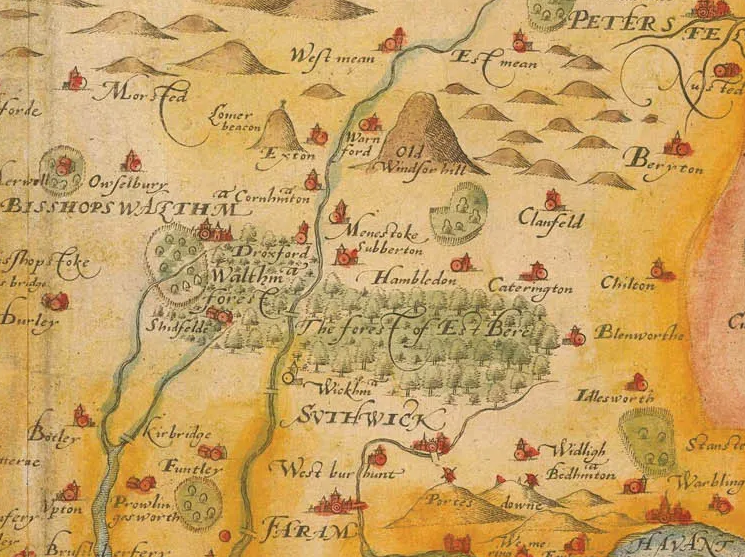
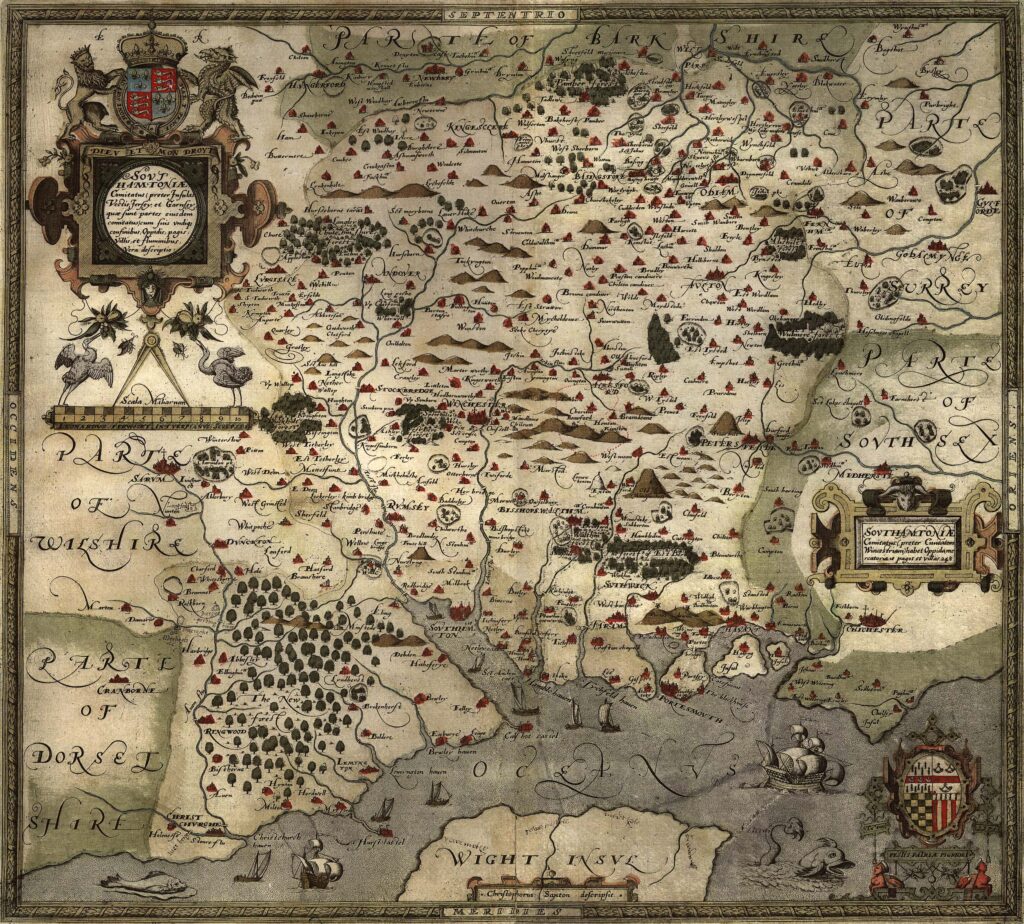
Christopher Saxton’s map of Hampshire, titled Southamtoniae, was engraved around 1575 as part of his systematic survey of England and Wales. The copperplate for the county was prepared during the main production phase of the atlas (c. 1574–1578), with engraving undertaken by Leonard Terwoort of Antwerp. At this stage, the map existed as an individual printed sheet.
In 1579, the same Hampshire plate was incorporated into the first collected edition of Saxton’s Atlas of England and Wales. No new Hampshire map was engraved in 1579; rather, impressions were taken from the existing copperplate and issued within the bound atlas volume.
Colouring and Quality (1575–1579)
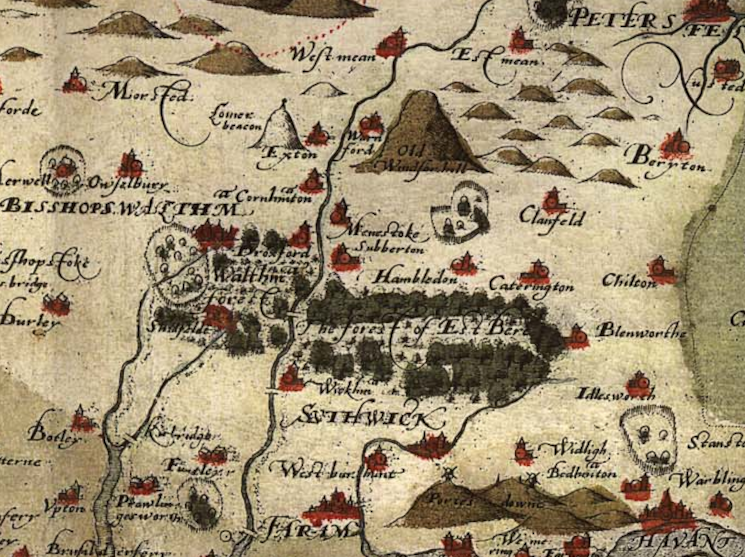
Colour was applied by hand after printing and was not part of the engraved process. As a result, quality varies between surviving examples.
Earlier impressions (c. 1575–1576)
– Often display strong, sharp engraving lines due to minimal plate wear.
– Colouring, when present, tends to be relatively restrained.
– Some early sheets may have been issued uncoloured.
Atlas issue impressions (1579)
– Still generally show crisp engraving, as the plates were relatively new.
– More consistently hand-coloured, especially in presentation copies.
– Colour schemes vary widely depending on the colourist.
Decorative elements such as coats of arms and cartouches were often more elaborately painted in atlas copies.
Because colouring was done individually, differences in intensity, palette, and neatness reflect workshop practice rather than date alone. There is no formal “1575 style” versus “1579 style” of colouring, but earlier loose sheets sometimes show simpler treatment, while atlas copies were more likely to receive fuller decorative colouring.
In summary, the distinction between 1575 and 1579 lies in format rather than cartographic revision: the Hampshire plate was engraved around 1575, and in 1579 it was issued as part of the complete atlas, with colouring quality dependent on the individual example rather than the year itself.